
SecurityBridge
SAP Security- Overview
- Setup
- Data & mappings
- Operations & API
- Changelog
The SecurityBridge connector integrates with SecurityBridge for SAP, an SAP-certified cybersecurity platform that runs natively inside the SAP system. It synchronizes the Patch-Management Notes per System data set — the matrix of SAP Security Notes evaluated against each SAP system — and normalizes it into Brinqa Assets (SAP systems), Vulnerability Definitions (SAP Security Notes), and Vulnerabilities (a note's implementation status on a system). A security-relevant SAP Security Note that is not yet implemented on a system is an open vulnerability (a missing patch) on that asset.
The connector reads SecurityBridge's SAP NetWeaver Gateway OData v2 service over HTTP and consumes the Atom (XML) response format.
Data retrieved from SecurityBridge
| Connector Object | Required | Maps to Data Model |
|---|---|---|
| Asset | Yes | Host |
| Vulnerability Definition | Yes | Vulnerability Definition |
| Vulnerability | Yes | Vulnerability |
Model relationships
For detailed steps on how to view the data retrieved from SecurityBridge in the Brinqa Platform, see How to view your data.
Connection settings
When setting up a data integration, select SecurityBridge from the Connector dropdown and provide the following:
| Setting | Required | Default | Description |
|---|---|---|---|
| API URL | Yes | — | SecurityBridge API URL |
| Username | Yes | — | SecurityBridge username |
| Password | Yes | — | SecurityBridge password |
| Page size | No | 100 | Maximum number of records to get per API request |
| Maximum retries | No | 5 | Maximum number of retry attempts before giving up a request |
Authentication
The connector authenticates with the SAP host using HTTP Basic authentication against a dedicated SAP
technical user. On every request the connector sets the Authorization header from the configured
username and password.
Method
| Element | Value |
|---|---|
| Method | HTTP Basic authentication |
Request Headers
| Header | Value |
|---|---|
Authorization | Basic <base64(username:password)> |
Accept | application/xml |
Usage
Every OData request includes the Basic authorization header:
Authorization: Basic <base64 encoded 'username:password'>
Sync Behavior
Each sync is a full sync. The connector does not maintain a sync token and does not apply an incremental
since filter, so every run re-fetches the complete set of records for each enabled model.
How to obtain SecurityBridge credentials
SecurityBridge Connector — Setup
This guide describes the SAP-side prerequisites required before the SecurityBridge connector can pull data. These steps are performed by the customer's SAP Basis / security team, not by Brinqa. The connector itself only needs a URL, a username, and a password see Configuration.
SecurityBridge exposes its data through an SAP NetWeaver Gateway OData v2 service. Access is protected by two independent security layers — both must pass or the request fails:
- HTTP authentication — proves who the user is (Basic credentials).
- SAP authorization — a separate SAP check that decides what the user may do (PFCG role).
1. Create a dedicated technical user
Create a dedicated, read-only technical / communication user in the target SAP system for the connector to authenticate as. Do not reuse a named person's dialog account.
- Recommended user type: Communication (Type C) or System (Type B), per your organization's policy.
- Assign a strong password and record the username and password — these become the connector's
usernameandpasswordconfiguration values.
2. Assign the required SAP authorizations (PFCG role)
Authenticating only proves identity. SAP then performs a separate authorization check using
authorization objects bundled into a PFCG role assigned to the technical user. The role must contain
three authorizations. A valid login that is missing any of these returns 403 (or an empty response
with an authorization error) rather than data.
2.1 SecurityBridge API permission — object /SECBR/API
The application-level gate that allows the user to call the Patch-Management API.
| Field | Value | Meaning |
|---|---|---|
/SECBR/VND | SB | Vendor = SecurityBridge |
/SECBR/API | PMNotesPerSystem | The specific API the user may call |
2.2 & 2.3 SAP Gateway service permission — object S_SERVICE
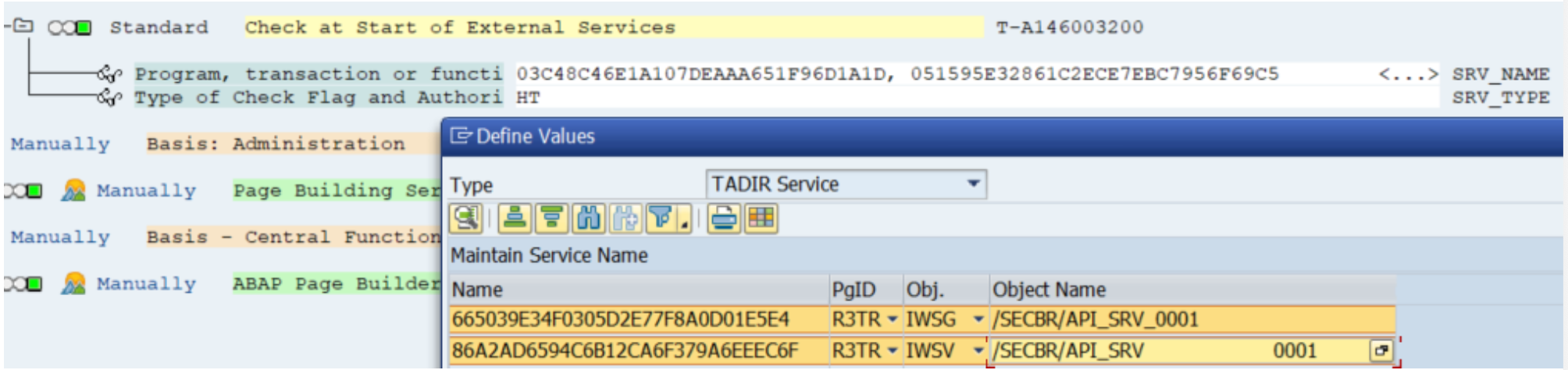
SAP's standard object for executing an OData/external service. SAP Gateway's two-part architecture requires the service to be authorized on both the frontend (hub) and backend sides — two entries for the same service:
| Entry | Object (type TADIR Service) | Object Name | SRV_TYPE |
|---|---|---|---|
| IWSG — Gateway Service Group metadata (hub/frontend) | IWSG | /SECBR/API_SRV_0001 | HT |
| IWSV — Gateway Business Suite Enablement (backend) | IWSV | /SECBR/API_SRV_0001 | HT |
SRV_TYPE = HT denotes an HTTP (OData) service.
SecurityBridge enforces two independent security layers — both must pass or the request fails:
- HTTP authentication — the Basic credentials prove who the user is (a
401indicates bad credentials). - SAP authorization — a separate SAP check decides what the user may do. The API user must be
assigned a PFCG role granting the SecurityBridge API authorization (
/SECBR/API) and the SAP Gateway service authorization (S_SERVICE, both theIWSGfrontend andIWSVbackend entries). A valid login that is missing these authorizations returns403or an empty/authorization-error response.
See SETUP for the full list of required SAP authorizations and the technical-user prerequisites the
customer's SAP Basis team must configure.
Attribute mappings
Expand the sections below to view the mappings between the source and the Brinqa data model attributes:
Asset
| Source Field Name | SDM Attribute |
|---|---|
_(constant)_ | STATUS |
_(runtime)_ | LAST_CAPTURED |
PMNotesPerSystem.AffectSysType | CATEGORIES |
PMNotesPerSystem.AssignedTags | TAGS |
PMNotesPerSystem.backupContactAOR | BACKUP_CONTACT_AOR |
PMNotesPerSystem.Dbsys | DBSYS |
PMNotesPerSystem.Landscape | LANDSCAPE |
PMNotesPerSystem.mainContactAOR | OWNER |
PMNotesPerSystem.System | UID |
PMNotesPerSystem.System | NAME |
PMNotesPerSystem.System | SYSTEM |
Vulnerability Definition
| Source Field Name | SDM Attribute |
|---|---|
_(runtime)_ | LAST_CAPTURED |
PMNotesPerSystem.Category | CATEGORIES |
PMNotesPerSystem.CVE | CVE_IDS |
PMNotesPerSystem.CVE | CVE_RECORDS |
PMNotesPerSystem.CVSS | CVSS_BASE_SCORE |
PMNotesPerSystem.Description | DESCRIPTION |
PMNotesPerSystem.KernelRelevant | KERNEL_RELEVANT |
PMNotesPerSystem.ManualActivity | MANUAL_ACTIVITY |
PMNotesPerSystem.Note | UID |
PMNotesPerSystem.Note | NAME |
PMNotesPerSystem.Patchday | PATCH_DAY |
PMNotesPerSystem.ReleasedOn | PUBLISHED_DATE |
PMNotesPerSystem.Severity | SOURCE_SEVERITY |
PMNotesPerSystem.Severity | SEVERITY |
PMNotesPerSystem.Severity | SEVERITY_SCORE |
PMNotesPerSystem.Version | REVISION |
Vulnerability
| Source Field Name | SDM Attribute |
|---|---|
_(runtime)_ | LAST_CAPTURED |
PMNotesPerSystem.Age | AGE |
PMNotesPerSystem.Comment | COMMENT |
PMNotesPerSystem.ImpactAssessmentText | IMPACT_ASSESSMENT |
PMNotesPerSystem.ImplementedBy | IMPLEMENTED_BY |
PMNotesPerSystem.ImplementedTimestamp | LAST_FIXED |
PMNotesPerSystem.ImplementedTransport | IMPLEMENTED_TRANSPORT |
PMNotesPerSystem.ImplState | SOURCE_STATUS |
PMNotesPerSystem.ImplStateText | IMPL_STATE |
PMNotesPerSystem.ImplStateText | PROVIDER_STATUS |
PMNotesPerSystem.Note | TYPE |
PMNotesPerSystem.ProcStatusText | PROC_STATUS |
PMNotesPerSystem.SLA | SLA |
PMNotesPerSystem.SolmanProcStatus | SOLMAN_PROC_STATUS |
PMNotesPerSystem.System | TARGETS |
PMNotesPerSystem.System + PMNotesPerSystem.Note | UID |
PMNotesPerSystem.System + PMNotesPerSystem.Note | NAME |
Operations & API
Expand each connector object to see its operation options, delta-sync behavior, and the API it uses. See connector operation options for how to apply operation options (keys and values are case-sensitive).
Asset
Operation options
| Option | Type | Default | Description |
|---|---|---|---|
released_on_from | Instant | — | Filter notes by release date, lower bound (ReleasedOnFrom, YYYYMMDD) |
released_on_to | Instant | — | Filter notes by release date, upper bound (ReleasedOnTo, YYYYMMDD) |
severities | String | — | Comma-separated note severities (Low, Medium, High, Hot News) |
impl_states | String | — | Comma-separated implementation-state codes (E, N, U, V, O, M, -) |
processing_statuses | String | — | Comma-separated processing-status codes (A, I, N, R, D, E, V) |
affected_system_types | String | — | Comma-separated affected system types (e.g. ABAP, JAVA) |
all_notes | Boolean | — | false = pending notes only; true = all existing notes |
page_size | Integer | 100 | Records per page ($top) |
max_retries | Integer | 5 | Maximum retry attempts per request |
Delta sync
Not supported. The connector performs a full sync of Asset on every run and applies no incremental date filter.
API
- Type: REST endpoint (OData v2, Atom/XML) · Endpoint:
GET /sap/opu/odata/SECBR/API_SRV/PMNotesPerSystemSet
- Asset coverage is note-driven. Only systems that have at least one note in the query window appear as Assets. Fully-patched systems with zero applicable notes are not returned by this endpoint and therefore do not sync as Assets.
Vulnerability Definition
Operation options
| Option | Type | Default | Description |
|---|---|---|---|
released_on_from | Instant | — | Filter notes by release date, lower bound (ReleasedOnFrom, YYYYMMDD) |
released_on_to | Instant | — | Filter notes by release date, upper bound (ReleasedOnTo, YYYYMMDD) |
severities | String | — | Comma-separated note severities (Low, Medium, High, Hot News) |
impl_states | String | — | Comma-separated implementation-state codes (E, N, U, V, O, M, -) |
processing_statuses | String | — | Comma-separated processing-status codes (A, I, N, R, D, E, V) |
affected_system_types | String | — | Comma-separated affected system types (e.g. ABAP, JAVA) |
all_notes | Boolean | — | false = pending notes only; true = all existing notes |
page_size | Integer | 100 | Records per page ($top) |
max_retries | Integer | 5 | Maximum retry attempts per request |
Delta sync
Not supported. The connector performs a full sync of Vulnerability Definition on every run and applies no incremental date filter.
API
- Type: REST endpoint (OData v2, Atom/XML) · Endpoint:
GET /sap/opu/odata/SECBR/API_SRV/PMNotesPerSystemSet
Vulnerability
Operation options
| Option | Type | Default | Description |
|---|---|---|---|
released_on_from | Instant | — | Filter notes by release date, lower bound (ReleasedOnFrom, YYYYMMDD) |
released_on_to | Instant | — | Filter notes by release date, upper bound (ReleasedOnTo, YYYYMMDD) |
severities | String | — | Comma-separated note severities (Low, Medium, High, Hot News) |
impl_states | String | — | Comma-separated implementation-state codes (E, N, U, V, O, M, -) |
processing_statuses | String | — | Comma-separated processing-status codes (A, I, N, R, D, E, V) |
affected_system_types | String | — | Comma-separated affected system types (e.g. ABAP, JAVA) |
all_notes | Boolean | — | false = pending notes only; true = all existing notes |
page_size | Integer | 100 | Records per page ($top) |
max_retries | Integer | 5 | Maximum retry attempts per request |
Delta sync
Not supported. The connector performs a full sync of Vulnerability on every run and applies no incremental date filter.
API
- Type: REST endpoint (OData v2, Atom/XML) · Endpoint:
GET /sap/opu/odata/SECBR/API_SRV/PMNotesPerSystemSet
- The finding lifecycle is driven by the SAP
ImplStatecode (Ncan be implemented,Uincompletely implemented,Mmanual check required, or blank) map to active; notes that are implemented or no longer applicable (Ecompletely implemented,Vobsolete version implemented,Oobsolete,-cannot be implemented) map to fixed.
Changelog
The SecurityBridge connector has undergone the following changes:
| Version | Description | Migration Steps |
|---|---|---|
| 3.0.0 | Overview The SecurityBridge connector integrates with SecurityBridge for SAP to synchronize SAP Patch-Management data — SAP systems, SAP Security Notes, and each note's implementation status per system — as assets, vulnerability definitions, and vulnerability findings. Category: SAP Security Models | N/A |