BrinqaIQ Assistant
What is BrinqaIQ Assistant?
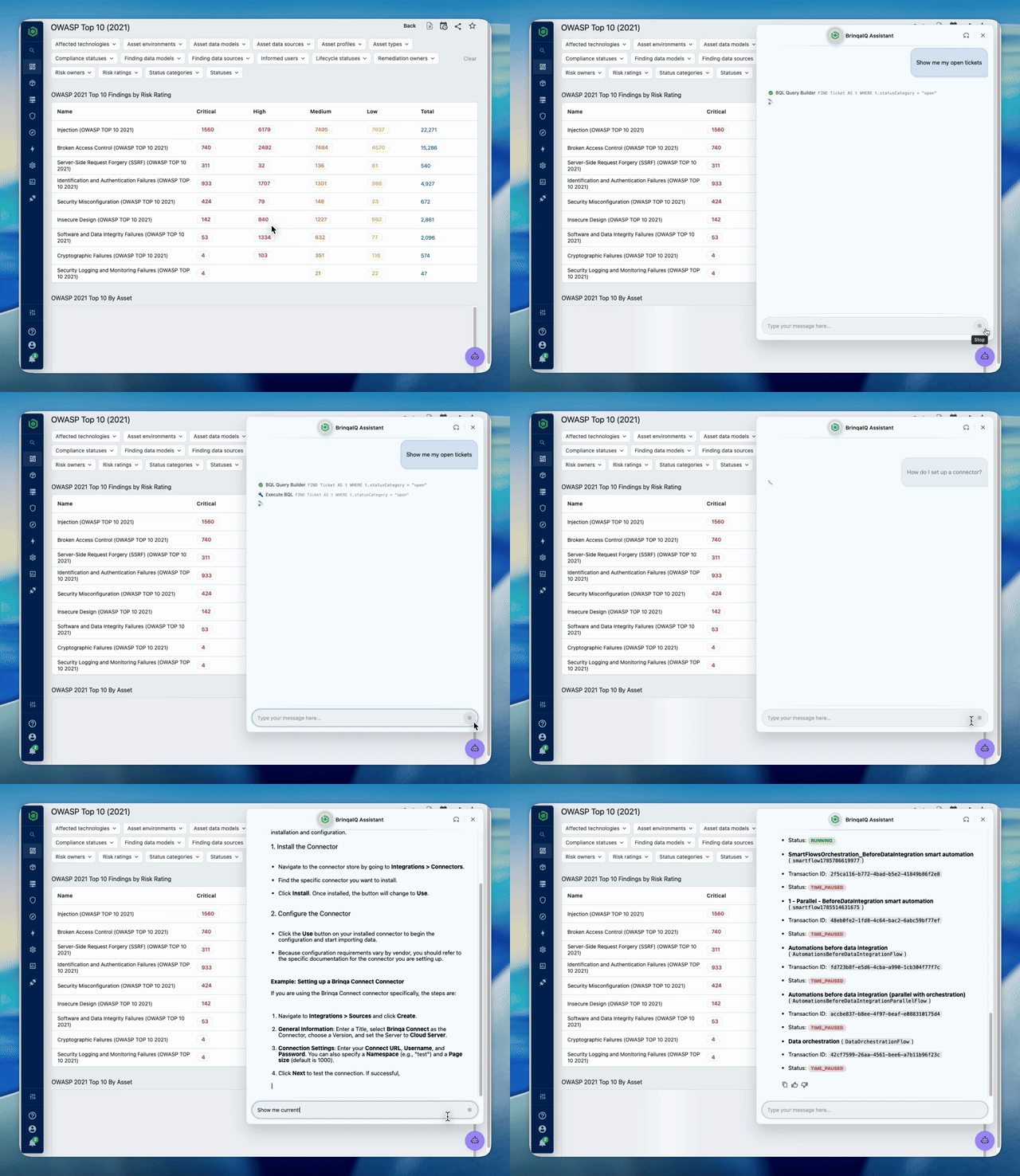
BrinqaIQ Assistant is a chatbot powered by self-hosted open-source models that is part of Brinqa’s broader BrinqaIQ AI initiative. It enhances your experience by helping you construct valid Brinqa Query Language (BQL) queries using natural language, answering Brinqa Platform documentation-related questions, and exploring CVEs (Common Vulnerabilities and Exposures).
What can BrinqaIQ do?
BrinqaIQ Assistant dispatches through the same tool registry as the BrinqaIQ MCP integration, so it supports the same set of capabilities:
- BQL generation — Describe in plain language the data you want; BrinqaIQ generates a valid BQL query for you.
- BQL execution — Run BQL queries directly against your Brinqa data and view the results in the chat interface.
- Docs Assistant — Ask questions about the Brinqa Platform and get answers drawn from the official documentation.
- CVE Explorer — Look up CVE details, severity ratings, affected products, and remediation context.
- Automation lifecycle management — Launch, resume, cancel, and check the status of automations and flows.
- Flows and automations discovery — List the flows enabled for API and MCP access, and all automations; inspect them by name or ID; and see which flows are currently running.
All actions are performed in the context of your logged-in user account. BrinqaIQ can only access data you already have permission to view in the Brinqa Platform.
How does BrinqaIQ work?
BrinqaIQ runs on self-hosted open-source models and uses Retrieval-Augmented Generation (RAG) to generate responses. When you submit a question or request, BrinqaIQ gathers relevant metadata or Brinqa Platform documentation and supplies it to the model to generate an accurate response. For BQL queries, it uses Brinqa Platform APIs to validate query syntax.
Can BrinqaIQ generate queries using custom data?
Yes. BrinqaIQ can analyze your custom data models, attributes, and relationships to assist with BQL query generation. It uses metadata retrieved from Brinqa Platform APIs during the session, such as model names, attribute types, and reference relationships. This metadata context is used only for the current session and is not stored after the session ends (except in cases of security monitoring or user feedback, as described in How long is my data retained?). Metadata is not used for model training.
What data does BrinqaIQ use to generate responses?
BrinqaIQ accesses only metadata and documentation—not your actual database records:
Accessible to BrinqaIQ:
- Data model metadata (names, types, descriptions, relationships)
- Attribute metadata (names, types, descriptions)
- Public Brinqa Platform documentation
Not accessible to BrinqaIQ:
- Database records (actual data values)
- Reports or dashboards
- Brinqa internal documentation
- Web searches or file uploads
All metadata is retrieved through Brinqa Platform APIs and is limited to what you already have permission to access.
Can I disable BrinqaIQ?
BrinqaIQ is disabled by default for each deployment. Your Brinqa Support team can enable or disable it for your environment at any time without affecting other Brinqa Platform features.
Once enabled for your deployment, all users with access to the Brinqa Platform can use BrinqaIQ. There are currently no per-user or role-based controls to restrict access within an enabled deployment.
Are there role-based permissions for BrinqaIQ?
BrinqaIQ access control has two layers:
Feature access: BrinqaIQ does not currently support role-based controls. If enabled for your deployment, all users can access the BrinqaIQ Assistant interface.
Data access: All queries respect your existing access controls. BrinqaIQ cannot retrieve or expose data that you do not already have permission to view in the Brinqa Platform. User permissions are enforced for all BQL queries, whether generated by BrinqaIQ or written manually.
Does BrinqaIQ have rate limits or quotas?
No. BrinqaIQ does not currently enforce rate limits or usage quotas.