
Claroty xDome
OT Security- Overview
- Setup
- Data & mappings
- Operations & API
- Changelog
The Claroty xDome connector integrates with the Claroty xDome (formerly Medigate) platform to synchronize OT/IoT/IoMT device inventory, security alerts, and vulnerability data. It retrieves device assets, alert definitions, alert findings (per device-alert pair), vulnerability definitions (CVEs), and vulnerability findings (per device-vulnerability pair) using the xDome REST API.
Data retrieved from Claroty xDome
| Connector Object | Required | Maps to Data Model |
|---|---|---|
| Device | Yes | Host |
| Alert Definition | Yes | Alert Definition |
| Alert | Yes | Alert |
| Vulnerability Definition | Yes | Vulnerability Definition |
| Vulnerability | Yes | Vulnerability |
Model relationships
For detailed steps on how to view the data retrieved from Claroty xDome in the Brinqa Platform, see How to view your data.
Connection settings
When setting up a data integration, select Claroty xDome from the Connector dropdown and provide the following:
| Setting | Required | Default | Description |
|---|---|---|---|
| Service URL | Yes | https://api.medigate.io | Claroty xDome API URL |
| API Key | Yes | — | Claroty xDome API key |
| Page Size | No | 5000 | Number of items to return per API request |
| Parallelism | No | min(4, availableProcessors) | Number of threads to spawn to make API requests |
Authentication
The connector authenticates with the Claroty xDome API using an API Key presented as a Bearer token. The key is generated in the Claroty xDome dashboard under Administration → Integrations → API Keys and supplied to the connector through the apiKey configuration property.
All xDome data endpoints are POST calls that accept a JSON request body. There is no separate token-exchange or login endpoint; the API key is sent directly on every request.
Endpoint
The connection is validated against the Devices endpoint with a minimal request:
| Method | URL |
|---|---|
POST | /api/v1/devices/ |
Request Headers
| Header | Value |
|---|---|
Content-Type | application/json |
Authorization | Bearer <api-key> |
User-Agent | BrinqaXdomeConnector/<version> |
Request Body
All endpoints share the same request-body contract. Fields, pagination, and filters are passed in the body:
{
  "fields": ["uid"],
  "offset": 0,
  "limit": 1,
  "include_count": true
}
Additional optional members used during sync:
{
  "fields": ["uid", "device_name", "ip_list"],
  "offset": 0,
  "limit": 5000,
  "include_count": true,
  "filter_by": {
    "field": "retired",
    "operation": "equals",
    "value": false
  },
  "sort_by": [
    { "field": "uid", "order": "asc" }
  ]
}
When more than one filter applies, they are composed with an and compound clause:
{
  "filter_by": {
    "operation": "and",
    "operands": [
      { "field": "device_retired", "operation": "equals", "value": false },
      { "field": "last_seen_list", "operation": "greater_or_equal", "value": "2024-01-01T00:00:00Z" }
    ]
  }
}
Sample Response
Responses are paginated envelopes. The top-level item key varies by endpoint (e.g. devices, alerts, vulnerabilities, devices_alerts, devices_vulnerabilities, sites):
{
  "count": 1342,
  "devices": [
    {
      "uid": "d3b07384-d9a0-4c9e-8b1a-1f2e3d4c5b6a",
      "device_name": "PLC-Line-2",
      "ip_list": ["10.0.4.21"]
    }
  ]
}
Response Fields
| Field | Type | Description |
|---|---|---|
count | Integer | Total number of matching records (returned only when include_count is true, used to drive parallel pagination) |
devices / alerts / vulnerabilities / devices_alerts / devices_vulnerabilities / sites | Array | The page of items; the key name depends on the endpoint being called |
Usage
The same API key is attached as a Bearer token on every request:
Authorization: Bearer <api-key>
Pagination is offset-based: the first page is fetched with include_count = true to obtain the total count, then the remaining pages are fetched in parallel using the offset/limit members.
Sync Behavior
The connector supports incremental (delta) syncs. It maintains a sync token between runs and applies it as an incremental timestamp filter, so each run re-processes only the records that changed after the previous sync. The initial run retrieves the complete data set; later runs are incremental. The specific timestamp field applied to each object is documented under that object's Sync Duration Parameter.
How to obtain Claroty xDome credentials
Obtain a Claroty xDome API key
For the Claroty xDome connector to use the Claroty API, you must create an API user and generate an API key. To do so, follow these steps:
-
Log in to your organization's Claroty xDome portal as an administrator.
-
Navigate to Settings > Admin Settings.
-
In the navigation menu, click User Management, and then click Add User.
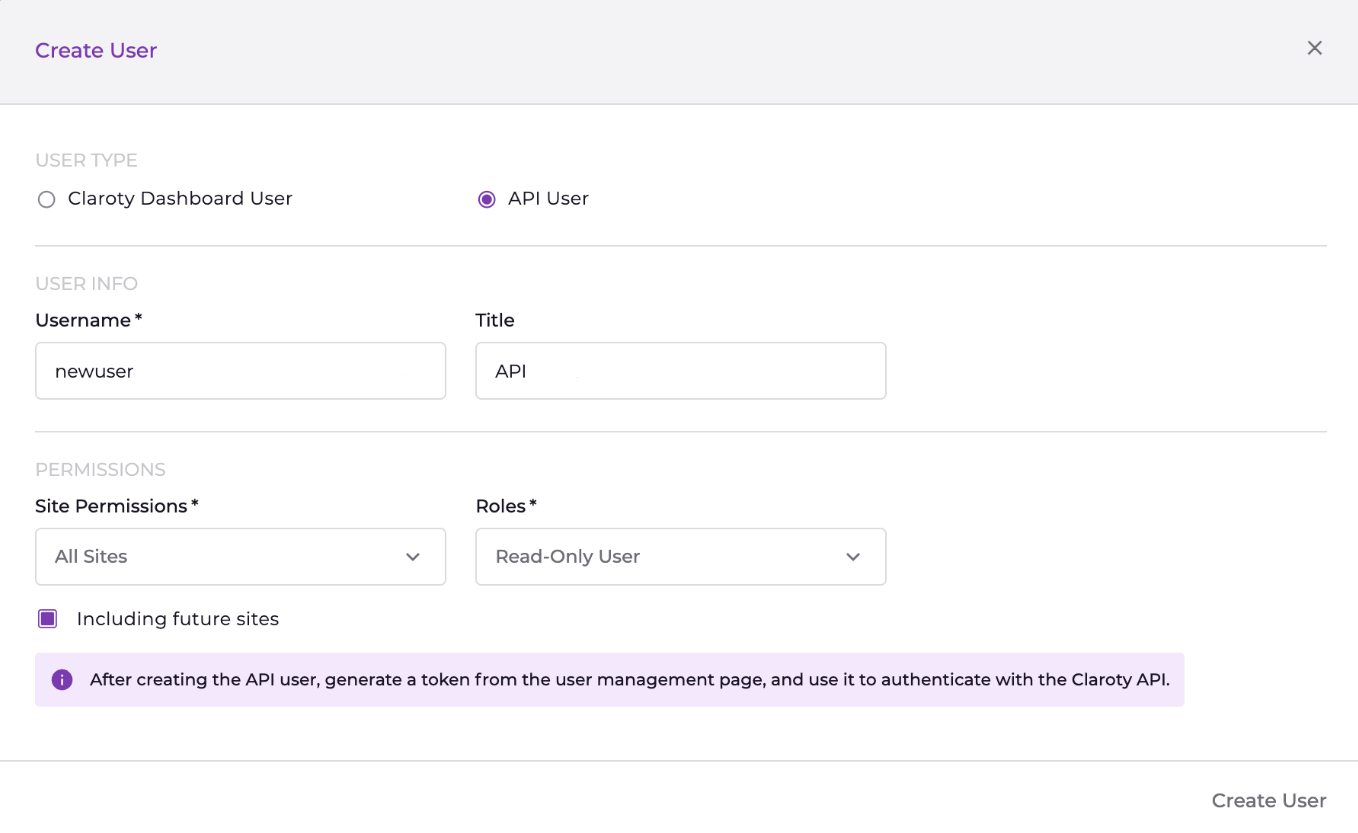
The Create User dialog appears. Complete the following fields:
-
User Type: Select API User.
-
User Info: Enter a user name and title (description) for the API key.
-
Note: This user name must be different from the Claroty xDome portal login user name.
-
Site Permissions: Click the dropdown and choose the necessary sites you want the Claroty xDome connector to have access to.
-
Roles: Click the dropdown and select Read-Only User.
-
Including future sites: (Optional) Enable this option to automatically grant access to any new sites added to your Claroty xDome environment. This ensures that the connector can retrieve data from all current and future sites without requiring manual updates to the site permissions.
-
Click Create User.
-
After creating the new user, click Generate Token.

The Generate API token dialog appears.
-
Click the Token Expiration dropdown and select the desired token expiry date.
-
Click Generate.
Your new API key displays. You can not view the key again after this. Copy and save it to a secure location.
Note: If you do not have permissions to create an API key, contact your Claroty xDome administrator.
Attribute mappings
Expand the sections below to view the mappings between the source and the Brinqa data model attributes:
Device
| Source Field Name | SDM Attribute |
|---|---|
DeviceResource.assetId | ASSET_ID |
DeviceResource.combinedOs | OPERATING_SYSTEM |
DeviceResource.combinedOs | COMBINED_OS |
DeviceResource.criticality | CRITICALITY |
DeviceResource.detectorName | DETECTOR_NAME |
DeviceResource.deviceCategory | CATEGORIES |
DeviceResource.deviceCategory | DEVICE_CATEGORY |
DeviceResource.deviceName | NAME |
DeviceResource.deviceName | DEVICE_NAME |
DeviceResource.deviceSubcategory | DEVICE_SUBCATEGORY |
DeviceResource.deviceType | DEVICE_TYPE |
DeviceResource.deviceTypeFamily | DEVICE_TYPE_FAMILY |
DeviceResource.endpointSecurityNames | ENDPOINT_SECURITY_NAMES |
DeviceResource.fdaClass | FDA_CLASS |
DeviceResource.firstSeenList[0] | FIRST_SEEN |
DeviceResource.internetCommunication | INTERNET_COMMUNICATION |
DeviceResource.ipList | IP_ADDRESSES |
DeviceResource.labels | TAGS |
DeviceResource.lastSeenList[0] | LAST_SEEN |
DeviceResource.macList | MAC_ADDRESSES |
DeviceResource.manufacturer | MANUFACTURER |
DeviceResource.mobility | MOBILITY |
DeviceResource.model | MODEL |
DeviceResource.networkList | NETWORKS |
DeviceResource.note | NOTE |
DeviceResource.purdueLevel | PURDUE_LEVEL |
DeviceResource.retired | STATUS |
DeviceResource.retired | RETIRED |
DeviceResource.riskScore | RISK_SCORE |
DeviceResource.riskScorePoints | RISK_SCORE_POINTS |
DeviceResource.serialNumber | SERIAL_NUMBER |
DeviceResource.siteName | SITE_NAME |
DeviceResource.uid | UID |
DeviceResource.vlanList | VLANS |
SiteResource.countryCode | SITE_COUNTRY_CODE |
SiteResource.location | SITE_LOCATION |
SiteResource.timezone | SITE_TIMEZONE |
| System-generated | LAST_CAPTURED |
Alert Definition
| Source Field Name | SDM Attribute |
|---|---|
AlertResource.alertClass | ALERT_CLASS |
AlertResource.alertTypeName | UID |
AlertResource.alertTypeName | NAME |
AlertResource.category, AlertResource.alertClass | CATEGORIES |
AlertResource.description | DESCRIPTION |
AlertResource.detectedTime | DETECTED_AT |
AlertResource.devicesCount | DEVICES_COUNT |
AlertResource.mitreTechniqueEnterpriseIds | MITRE_ENTERPRISE_IDS |
AlertResource.mitreTechniqueEnterpriseNames | MITRE_ENTERPRISE_NAMES |
AlertResource.mitreTechniqueIcsIds | MITRE_ICS_IDS |
AlertResource.mitreTechniqueIcsNames | MITRE_ICS_NAMES |
AlertResource.status | ALERT_STATUS |
AlertResource.unresolvedDevicesCount | UNRESOLVED_DEVICES_COUNT |
AlertResource.updatedTime | UPDATED_AT |
MITRE technique names (ICS + Enterprise) | TAGS |
| System-generated | LAST_CAPTURED |
Alert
| Source Field Name | SDM Attribute |
|---|---|
| alertId:deviceUid | UID |
DeviceAlertRelationResource.alertCategory | ALERT_CATEGORY |
DeviceAlertRelationResource.alertClass | ALERT_CLASS |
DeviceAlertRelationResource.alertLabels | TAGS |
DeviceAlertRelationResource.alertTypeName | TYPE |
DeviceAlertRelationResource.deviceAlertDetectedTime | DETECTED_AT |
DeviceAlertRelationResource.deviceAlertStatus | PROVIDER_STATUS |
DeviceAlertRelationResource.deviceAlertUpdatedTime | UPDATED_AT |
DeviceAlertRelationResource.deviceUid | TARGETS |
| Normalized from PROVIDER_STATUS | SOURCE_STATUS |
| System-generated | LAST_CAPTURED |
Vulnerability Definition
| Source Field Name | SDM Attribute |
|---|---|
| Derived from normalized severity | SEVERITY_SCORE |
| System-generated | LAST_CAPTURED |
VulnerabilityResource.adjustedVulnerabilityScore | ADJUSTED_SCORE |
VulnerabilityResource.adjustedVulnerabilityScoreLevel | SEVERITY |
VulnerabilityResource.adjustedVulnerabilityScoreLevel | SOURCE_SEVERITY |
VulnerabilityResource.adjustedVulnerabilityScoreLevel | ADJUSTED_SCORE_LEVEL |
VulnerabilityResource.affectedDevicesCount | AFFECTED_DEVICES_COUNT |
VulnerabilityResource.cveIds | CVE_IDS |
VulnerabilityResource.cveIds | CVE_RECORDS |
VulnerabilityResource.cvssV2VectorString, cvssV3VectorString | CVSS v2/v3 metrics |
VulnerabilityResource.description | DESCRIPTION |
VulnerabilityResource.epssScore | EPSS_SCORE |
VulnerabilityResource.exploitsCount | EXPLOITS_COUNT |
VulnerabilityResource.isKnownExploited | IS_KNOWN_EXPLOITED |
VulnerabilityResource.name | UID |
VulnerabilityResource.name | NAME |
VulnerabilityResource.publishedDate | PUBLISHED_DATE |
VulnerabilityResource.sourceName | SOURCE_NAME |
VulnerabilityResource.sourceUrl | SOURCE_URL |
VulnerabilityResource.vulnerabilityLabels | TAGS |
VulnerabilityResource.vulnerabilityPriorityGroup | PRIORITY_GROUP |
VulnerabilityResource.vulnerabilityType | CATEGORIES |
VulnerabilityResource.vulnerabilityType | VULNERABILITY_TYPE |
Vulnerability
| Source Field Name | SDM Attribute |
|---|---|
| Derived from vulnerabilityRelevance | PROVIDER_STATUS |
DeviceVulnerabilityRelationResource.deviceUid | TARGETS |
DeviceVulnerabilityRelationResource.deviceVulnerabilityDetectionDate | DETECTION_DATE |
DeviceVulnerabilityRelationResource.deviceVulnerabilityResolutionDate | RESOLUTION_DATE |
DeviceVulnerabilityRelationResource.vulnerabilityAdjustedVulnerabilityScoreLevel | ADJUSTED_SCORE_LEVEL |
DeviceVulnerabilityRelationResource.vulnerabilityLabels | TAGS |
DeviceVulnerabilityRelationResource.vulnerabilityName | TYPE |
DeviceVulnerabilityRelationResource.vulnerabilityRelevance | VULNERABILITY_RELEVANCE |
| Normalized from PROVIDER_STATUS | SOURCE_STATUS |
| System-generated | LAST_CAPTURED |
| vulnerabilityId:deviceUid | UID |
Operations & API
Expand each connector object to see its operation options, delta-sync behavior, and the API it uses. See connector operation options for how to apply operation options (keys and values are case-sensitive).
Device
Operation options
| Option | Type | Default | Description |
|---|---|---|---|
excludeRetired | Boolean | true | Exclude retired devices from sync |
enrichSites | Boolean | false | Enable site enrichment (adds location, timezone, country code from /api/v1/sites/get) |
Delta sync
Supported. The connector performs an incremental (delta) sync via the since sync token, filtering on last_seen_list.
API
- Type: REST POST endpoint · Endpoint:
POST /api/v1/devices/ - Default filters:
retired = false(excludes retired devices)
Alert Definition
Operation options
| Option | Type | Default | Description |
|---|---|---|---|
excludeResolved | Boolean | true | Exclude resolved alert definitions from sync |
Delta sync
Supported. The connector performs an incremental (delta) sync via the since sync token, filtering on updated_time.
API
- Type: REST POST endpoint · Endpoint:
POST /api/v1/alerts/ - Default filters:
status != "Resolved"(excludes resolved alerts)
Alert
Operation options
| Option | Type | Default | Description |
|---|---|---|---|
excludeRetired | Boolean | true | Exclude alerts on retired devices |
Delta sync
Supported. The connector performs an incremental (delta) sync via the since sync token, filtering on device_alert_updated_time.
API
- Type: REST POST endpoint · Endpoint:
POST /api/v1/device_alert_relations/ - Default filters:
device_retired = false(excludes alerts on retired devices)
Vulnerability Definition
Operation options
This object does not support any operation options.
Delta sync
Supported. The connector performs an incremental (delta) sync via the since sync token, filtering on published_date.
API
- Type: REST POST endpoint · Endpoint:
POST /api/v1/vulnerabilities/ - Default filters: None (must sync all CVEs for TYPE linkage)
Vulnerability
Operation options
| Option | Type | Default | Description |
|---|---|---|---|
excludeRetired | Boolean | true | Exclude vulnerabilities on retired devices |
excludeIrrelevant | Boolean | false | Exclude vulnerabilities with relevance "Irrelevant" |
severityLevels | String | (unset) | Comma-separated Adjusted Vulnerability Score levels to sync, e.g. Critical,High. Unset syncs every level. |
Delta sync
Supported. The connector performs an incremental (delta) sync via the since sync token, filtering on vulnerability_last_updated.
API
- Type: REST POST endpoint · Endpoint:
POST /api/v1/device_vulnerability_relations/ - Default filters:
device_retired = false(excludes vulnerabilities on retired devices)
Changelog
The Claroty xDome connector has undergone the following changes:
| Version | Description | Migration Steps |
|---|---|---|
| 3.0.5 | New Features - Vulnerability: Added a severityLevels option that scopes the sync to specific Adjusted Vulnerability Score levels (for example Critical,High). Filtering is applied at the API, so excluded findings are never transferred — useful in large OT/IoT/IoMT environments where low and medium findings dominate volume but are not acted on. The option is unset by default and existing configurations continue to sync every severity level. Bug Fixes - Vulnerability: The excludeIrrelevant option now actually excludes irrelevant vulnerabilities. It filtered on the value irrelevant, but the API reports relevance as Irrelevant, so the filter matched nothing and the option had no effect. Connectors that had this option enabled were still syncing irrelevant vulnerabilities; enabling it now reduces the number of findings synced, as originally intended. - Vulnerability: Incremental sync now picks up status changes on vulnerabilities that were already synced in an earlier run. Previously the incremental filter used only device_vulnerability_detection_date — a one-time stamp set when a vulnerability is first detected on a device and never updated afterwards — so remediations, relevance re-verdicts, and rescores were invisible between full resyncs, and status could lag indefinitely. Incremental sync now also matches on vulnerability_last_updated, which tracks the most recent relevance-verdict change. Both fields are applied, so newly-detected vulnerabilities continue to be captured as before. | • Vulnerability: Changing severityLevels after the initial sync requires a full resync. Findings brought into scope by a widened filter are not backfilled by incremental syncs. • Vulnerability: Status changes that occurred while the previous behavior was in effect were never synced, and will not be backfilled by ordinary incremental runs — the affected records fall outside every future sync window. Action: run one full resync of the Vulnerability model after upgrading to bring existing findings up to date. Incremental syncs are sufficient from then on. |
| 3.0.4 | Improvements - Devices discovered in Claroty xDome are now synchronized to the standard Host model, aligning the connector with Brinqa's host-centric Unified Data Model. The associated asset category is also updated from Device to Host. - Expanded the set of Host identifiers used for record matching to include serial number, MAC addresses, and IP addresses, improving deduplication when correlating xDome devices with Host records from other sources. | • Device: The target model has changed from Device to Host. Action: purge previously synced Device records from this connector and re-sync to repopulate them as Host assets. |
| 3.0.3 | New Features - Added synchronization of vulnerabilities and vulnerability definitions from Claroty xDome, surfacing CVE-level exposure for each device along with shared definition details such as severity and description. - Added synchronization of alerts and alert definitions, bringing xDome security alerts and their reusable alert types into Brinqa as findings. Improvements - Device records are now enriched with site information, providing additional location and grouping context for each synchronized device. | N/A |
| 3.0.2 | Improvements - Devices now use the device name reported by Claroty xDome as their display name when available, falling back to asset ID or serial number. This produces clearer, more recognizable device names in Brinqa. | N/A |
| 3.0.1 | Improvements Dependency Upgrades Upgraded internal framework and model libraries to the latest stable versions for improved reliability, security patches, and alignment with the rest of the connector platform. | N/A |
| 3.0.0 | Overview The Claroty xDome connector integrates with Claroty xDome to synchronize discovered devices as assets in Brinqa. Category: OT Security Models | N/A |